News Items
Further details:
Cabin Living News log cabin kits Oxford Installation London Installation Southport Installation Log Cabin Planning Garden Office Insulation Blackpool log cabin Installation Log cabin Installation in Scotland Do you offer an installation service? Spread the log "cabin living" word Made to measure log cabins Garden office - gives you extra room Log Cabins UK Luxury log cabins log cabins garden studio buy a summer house for the gardenCabin Living News.
In England and Wales:
Under new rules your log cabin will need to be less than 2.5m ridge height if within 2m of a boundary. This does not apply in Scotland
View our specially designed 2.5m high range
The law is slightly different between England, Wales and Scotland.
Advice and tips for log cabin planning permission.
- The cabin should be at least 5 metres from your home.- This rule still applies in Scotland but no longer applies in England and Wales
(It could be closer but, in Scotland, you would have to submit a planning application with associated fees as it will be treated as an extension)
- The log cabn must be less than 4m high with a pitched roof or 3m with a flat roof. (still applies everywhere for log cabins more than 2m from a boundary)
(Cabin Living log cabins are less than 4m high with a pitched roof.)
- choose a cabin with a reduced ridge height (2.5m) if building close to a boundary fence in England and Wales
- If the floor area of the building is less than 15 metres square, it can be sited close to a boundary. (must be less than 2.5m ridge height in England and Wales)
(Cabin Living would still suggest a 0.5 metre gap to allow maintenance of your boundary and cabin.)
- If between 15 and 30 metres square there should be at least 1 metre to any boundary to comply with building regulations.
- The log cabin should take up less than 50% of the garden surrounding the house. (less than 30% in Scotland)
The planning portal is geared towards England and Wales but it is a useful reference in all cases.
Click here to visit the planning portal: Planning portal
If you are in Scotland your development is likely to be Class 3 of the Town and Country Planning (General Permitted Development)(Scotland)Order 1992 which can be viewed at: General Permitted Development Scotland
You will need to apply for planning permission if any of the following
cases apply on the land around your house.
- You want to put up a building or structure which would be nearer to any
highway than the nearest part of the "original house", unless
there would be at least 20 metres between the new building and any highway.
The term "highway" includes public roads, footpaths, bridleways
and byways.
- More than half (50%) the area of land around the "original house" would be covered by additions or other buildings. (Please note: 30% of the garden area in Scotland)
- The building or structure is not to be used for domestic purposes and is to be used instead, for example, for parking a commercial vehicle, running a business or for storing goods in connection with a business.
- You want to put up a building or structure which is more than 3 metres high, or more than 4 metres high if it has a ridged roof. (Measure from the highest ground next to it.)
- If your house is a listed building, and you want to put up a building or structure with a volume of more than 10 cubic metres.
- If you live in a Conservation Area, a National Park, an Area of Outstanding
Natural Beauty, or the Broads, and you want to put up a building or structure
with a volume of more than 10 cubic metres (though it might be allowable
as an extension)
The term "original house" means the house
as it was first built or as it stood on 1 July 1948 (if it was built
before that date). Although
you may not have built an extension to the house, a previous owner may
have done so.
If you have any concerns about a legal problem involving
planning you should get professional advice or ask your local planning
department.
For peace of mind we advise you to contact your local development control officer. It is likely they will ask you to submit a plan indicating where and what you intend to build. Your council should not apply any fees for this type of enquiry as this is not a planning application as such.
Information to include with your submission:
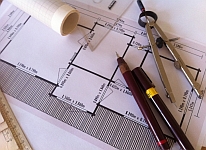
- an accurate dimensioned plan of your site showing cabin orientation, your home and clearly marked boundaries. This should be to scale probably 1:100
- a photograph of your site
- a site plan
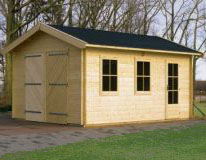
- an picture of your proposed log cabin
- floor dimensions of your log cabin (floor dimension guides for the complete Cabin Living range can be viewed at Log Cabin Detailed Drawings)
a site plan
Whilst it is useful to have a site plan as shown above you should also submit a dimensioned drawing to scale probably 1:100 or 1:50
It is advisable to point out in your accompanying letter how you have complied with current rules.
Finally,
wait for receipt of a letter confirming that your development has
been accepted
prior
to building
your cabin. Councils do vary but response to this type of enquiry is normally
fairly quick. (One week or so)
This may seem like a time consuming process but obtaining approval secures peace of mind and ensures that if you sell your property in the future you can furnish your buyer's solicitor with written approval from development control.
We hope you have found this article of interest and if you require further information regarding supply or installation of log cabins please view our log cabins
The Cabin Living Team